Project Overview
Handwritten Text Recognition (HTR) is when a machine “convert[s] handwritten text into a machine-encoded format” (Garrido-Munoz et al., 2026, p. 4367). The process itself is always complex, as there is “inherent variability in human handwriting” (Garrido-Munoz et al., 2026, p. 4367), but transcribing legacy linguistic fieldnotes like those in the Don Frantz Blackfoot Language Archive are particularly difficult for HTR, as they contain a mix of English, Frantz’s Blackfoot orthography, and IPA.
Niitsi’powahsiniBlackfoot is an endangered language spoken by the Niitsitapi people, specifically, the Apatohsipiikani, Kainai, and Siksika of Alberta and Aamskaapipiikani of Montana. In 2021, the University of Lethbridge came into the possession of the materials from Donald G. Frantz’s fieldwork on Blackfoot, which spanned the 1960s to 2010s. These materials form the basis for the most up-to-date Blackfoot dictionary (Frantz & Russell, 2017) and grammar (Frantz, 2017). Among these materials are seven reel-to-reel tapes with four recordings each, most coming with a matching handwritten transcription. The transcriptions capture elicitation sessions, Blackfoot stories, Bible translations, as well as rhythm patterns and pitch accent notes. With approximately 25 pages per transcription, there are up to 700 pages of transcriptions. Although all the transcriptions have been digitized, none have gone through Optical Character Recognition (OCR) and, save for 75 pages from 2024, none have been digitally transcribed by students.
As Nockels et al. (2024) explain, “HTR holds the possibility of preserving endangered language texts, increasing their accessibility and profile” (p. 154). In addition to this, researchers using HTR on endangered and Indigenous language materials cite natural language processing (NLP) and digital tool building as the main reasons why they do this work (Zhang et al., 2022). Both apply to the reel-to-reel transcriptions, but machine-readable text could also allow people to search the archive for words in context and could serve as data for revitalization resources.
Research Outcome
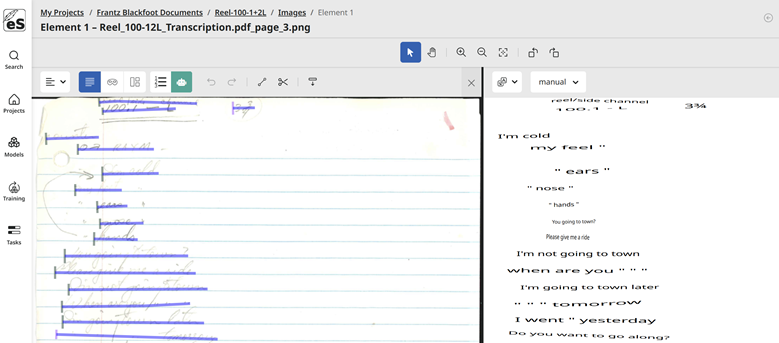
The primary research outcome is to create a custom HTR model for the reel-to-reel transcriptions in the Blackfoot Language Archive and transcribe all 700 pages. The open-source software eScriptorium is used; it runs Kraken, a recognition system “designed as a universal text recognizer for the humanities” (Kiessling, n.d.). The HTR model, “Frantz hand”, is preliminarily trained on 50 of the 75 pages the 2024 team of research assistants transcribed; the last 25 pages are reserved for fine-tuning the model. Once all pages have been processed, the product will be returned to the Blackfoot Language Archive to be handled according to the community’s wishes.
About the researcher
Jocelyn McKnight is an Mphil student in Linguistics at the University of Hong Kong. She is also a recent alum of the University of Lethbridge, where she earned a BA in English, French, and Linguistics. Her academic interests revolve around Old English philology, linguistics of all kinds (but especially the cognitive semantics kind), and Digital Humanities. Jocelyn has continued her work for the Visionary Cross Project and was an RA for the Blackfoot Language Archive and TA in the Linguistics and Modern Language Department, all at the University of Lethbridge.
For inquiries, please contact
jocelyn.mcknight@connect.hku.hk
atlab@hku.hk