
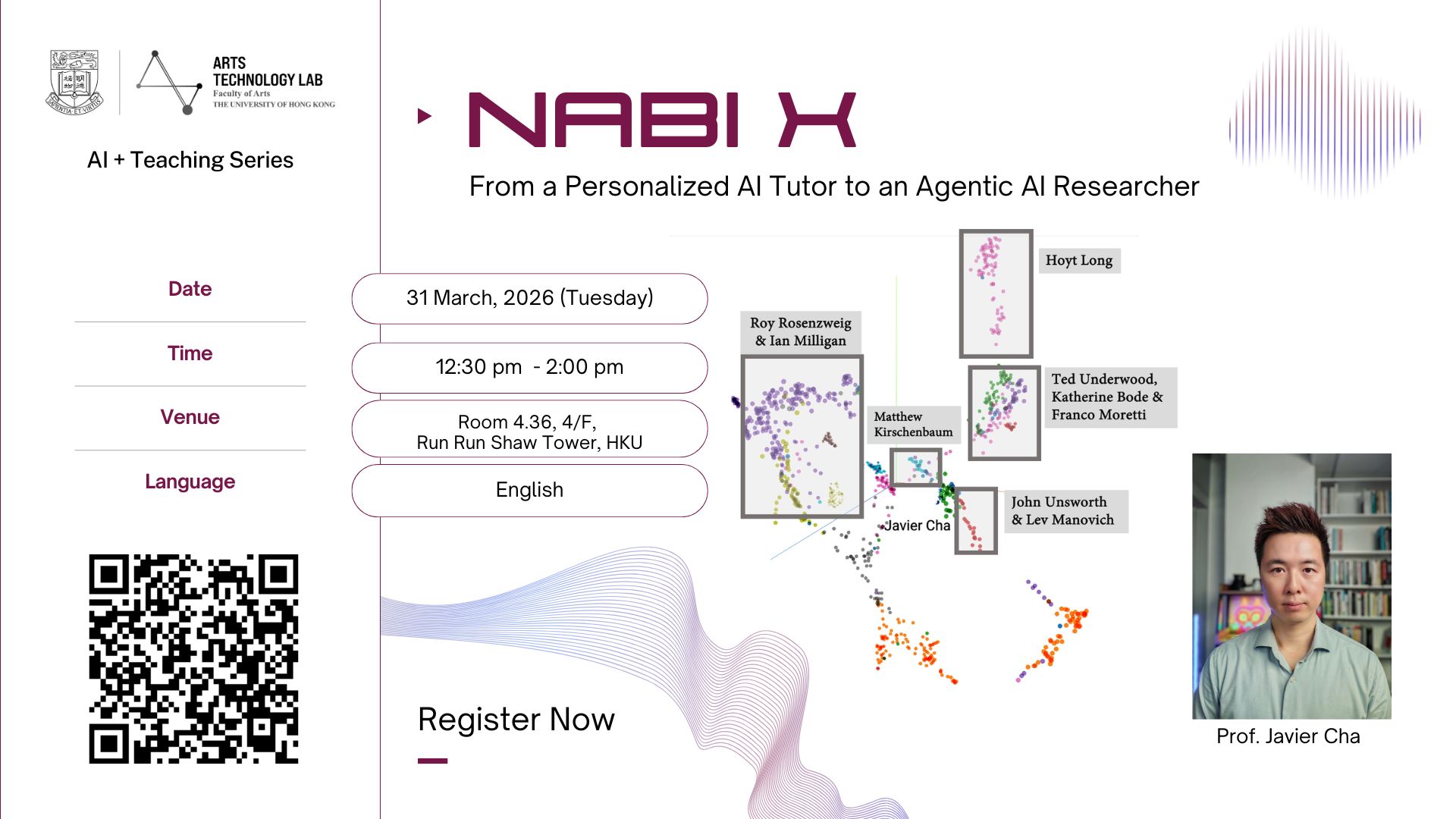
Abstract
This talk introduces Nabi X, an educational AI system developed by the Big Data Studies Lab in the Faculty of Arts, with support from HKU’s Teaching Development Grant (TDG) and Teaching Development and Language Enhancement Grant (TDLEG). Nabi X enforces a strict division between discipline-specific knowledge bases and large language models (LLMs) to minimize the occurrence of hallucinated responses. Students learn to co-create and contribute to their own knowledge base, and instructors may optionally upload notes containing valuable contextual information and tacit disciplinary knowledge.
Nabi X’s modular architecture retrieves knowledge through vector embeddings and generates context-aware responses using smaller, energy-efficient open-weight LLMs. An alpha version has been piloted in several of PI Javier Cha’s courses: HIST4037 (Automating the Past: Artificial Intelligence and the Historian’s Craft), HIST2218 (Medieval and Early Modern Korea), and HUDT3001 (Advanced Topics in Humanities and Digital Technologies).
The centerpiece of Nabi X is a navigable 3D “landscape of knowledge,” where related works cluster together. The team has intentionally moved away from the minimalist interface common to commercial generative AI tools such as ChatGPT, Gemini, DeepSeek, and Grok, which tend to encourage generic zero-shot prompting. Instead, Nabi invites students and instructors to work within a defined vector space relevant to their query, adjust output entropy (with a clear disclaimer that more “creative” responses may increase the risk of hallucination), and actively contribute user-curated entries to the system’s knowledge base. The goal is to break down complex ideas into semantic patterns, clarify conceptual relationships, and offer a clearer sense of the intellectual terrain of course materials—while demystifying the “black box” nature of generative AI and promoting more transparent and responsible uses of the technology.
In this presentation, Cha will discuss how his team designed, developed, and deployed Nabi X. The talk will conclude by outlining new directions that explore Nabi X’s potential evolution into an autonomous, agentic AI researcher, and will invite discussion on the broader implications of such developments.
Date: March 31, 2026 (Tuesday)
Time: 12:30 pm – 2:00 pm
Language: English
Venue: Room 4.36, 4/F, Run Run Shaw Tower, Centennial Campus, HKU
About the Speaker

Javier Cha is a digital historian and medievalist who uses technology to explore the East Asian world a millennium ago and also aims to prepare the historical profession for an era of data abundance and automation. His research spans the translation of primary sources in classical Chinese, machine-assisted historical methods, and experimental projects that address the challenges posed by big data and artificial intelligence in the humanities.
Cha has secured over HK$16 million (US$2 million) in competitive grants and fellowships from the Hong Kong Research Grants Council, the Academy of Korean Studies, the Korea Foundation, the University of Hong Kong, Seoul National University, and the Social Sciences and Humanities Research Council of Canada. Most recently, he has been selected as one of the inaugural recipients of the Schmidt Sciences Humanities and AI Virtual Institute (HAVI) award of up to HK$5.3 million (US$680,000) for the “Playing Heaven” project, which aims to leverage transformer-based machine learning to develop sound computational methodologies for the intellectual and cultural history of early modern Neo-Confucianism.
In 2025, Cha launched Nabi X, a modular and responsible AI-assisted learning platform developed by his Big Data Studies Lab team with support from HKU’s Teaching Development Grant and Teaching Development and Language Enhancement Grant. Nabi X seeks to demystify artificial intelligence by allowing students to work directly with curated datasets, word embeddings, and knowledge graphs instead of treating AI as a black box.
He is the recipient of the Faculty of Arts’ Teaching Excellence Award 2024–25 in the Teaching Innovation in E-learning category.
This event is hosted by the HKU Arts Tech Lab.
For enquiries, please contact atlask@hku.hk